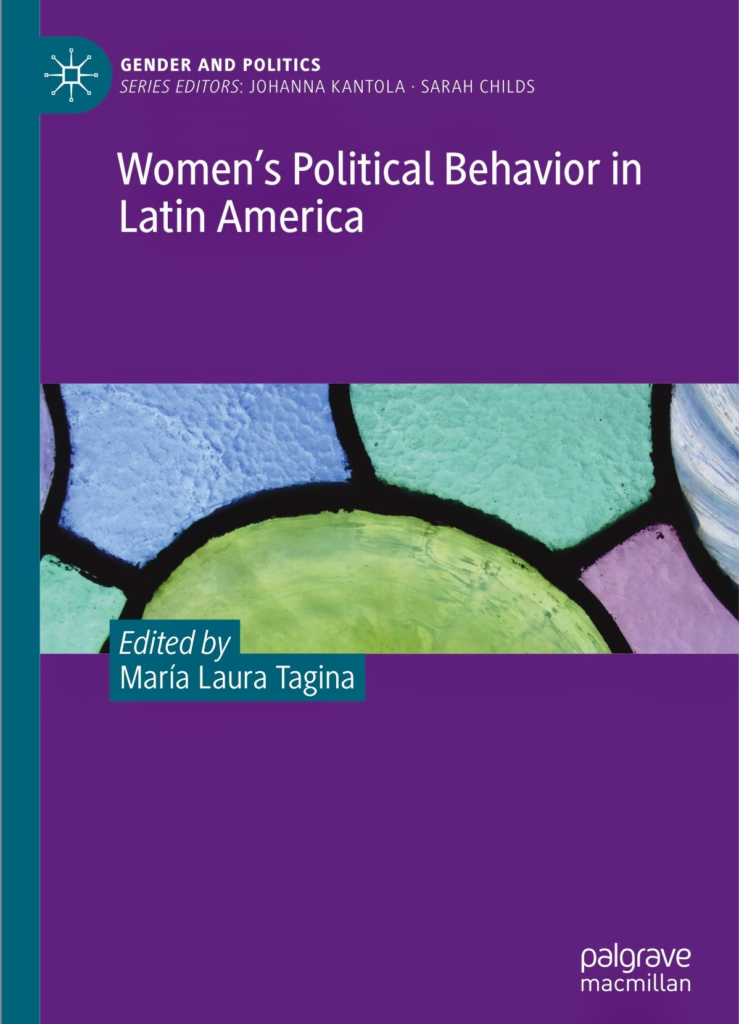
Se difunde a todos el libro ‘Women’s Political Behaviour in Latin America‘, editado por la profesora María Laura Tagina (UNSM) y publicado por Palgrave Macmillan.
María Laura Tagina es profesora titular e investigadora de tiempo completo en la Universidad Nacional de San Martín (Argentina) y profesora titular con dedicación simple en la Universidad Nacional de La Matanza (Argentina).
Abstract [Eng]
«Bringing together experts from across the region, this book examines the impact of gender on political behavior in Latin America. Eighteen country-case studies provide invaluable insights into the distinctive characteristics of women’s political behavior, paying particular attention to themes such as female-voter turnout, voter ideology, support for populist radical parties, and support for female candidates. The volume also seeks to explain how female political behavior has changed over the last few decades, and how it has permutated in different ways both within and across countries. This includes several factors, including changes to the labour market, attitudes toward religion and marital status, as well as political reforms and the growth of feminist movements. The first book to comprehensively analyse female political behavior across Latin America, the volume is an essential resource for those interested in democracy studies, gender studies, and Latin American politics. «
Resúmen [ESP]
«Reuniendo a expertos de toda la región, este libro examina el impacto del género en el comportamiento político en América Latina. Dieciocho estudios de caso por país proporcionan valiosas perspectivas sobre las características distintivas del comportamiento político de las mujeres, prestando especial atención a temas como la participación electoral femenina, la ideología del votante, el apoyo a partidos populistas radicales y el respaldo a candidatas mujeres. El volumen también busca explicar cómo ha cambiado el comportamiento político femenino en las últimas décadas y cómo ha variado de diferentes maneras tanto dentro de cada país como entre ellos. Esto incluye varios factores, como los cambios en el mercado laboral, las actitudes hacia la religión y el estado civil, así como las reformas políticas y el crecimiento de los movimientos feministas. Primer libro que analiza de manera integral el comportamiento político femenino en toda América Latina, esta obra es un recurso esencial para quienes se interesan por los estudios de democracia, los estudios de género y la política latinoamericana.»
Contenido del libro:
- Introduction. Gender as an Explanatory Factor in Political Behaviour
- Gender Gaps in Women’s Electoral Behaviour in Argentina
- What Gender Gap? The Female Vote in Bolivia
- #EleNão: Female Autonomy and Far-Right Populist Candidacy in Brazil’s 2010–2022 Presidential Elections
- Two Changing Gender Gaps: Women’s Vote in Chile, 1989–2021
- The Political Preferences and Turnout of Colombian Women Voters: 2018–2023
- Does a Gender Gap Exist in the Voting Choices of Costa Ricans?
- Women’s Vote in the Dominican Republic
- Ecuadorian Women at the Ballot Box: A Demand-Side Analysis of Gender in Politics
- Whom Do Women Vote for? An Analysis of Honduran Electoral Behaviour
- Do Women “Mind the (Gender) Gap”? The Turnout, Ideology, and Voting of the Female Electorate in Mexico
- Women’s Electoral Behavior Under Conditions of Democratic Erosion: Nicaragua, El Salvador, and Guatemala
- The Electoral Behavior of Women in Panama
- Gender Gaps in Paraguay: Voting for Traditional Right-Wing Parties and the Rise of the Radicalized Right
- Too Traditional? Voting and Gender Gap in Peru, 2000–2021
- A Gender Gap in Political Behavior in Uruguay
- Patterns of Female Political Participation in Venezuela (2000–2025)
- Gender Gaps in the Political Behaviour of Latin American Women
Link / Enlace: https://link.springer.com/book/10.1007/978-3-032-08580-1